Basic Crochet Stitches Tutorial

Basic Crochet Stitches are the foundation of every crochet project, from delicate baby blankets to cozy winter scarves and decorative home accessories.
If you are just starting your journey into the world of yarn crafts, understanding Basic Crochet Stitches will give you the confidence and technical knowledge you need to move forward with more complex patterns. These stitches are the building blocks that allow creativity to flourish while maintaining structure and consistency in your work.
When learning Basic Crochet Stitches, it’s important to approach the process with patience and curiosity. Crochet is both a relaxing hobby and a practical skill, and mastering the fundamentals will make every future project smoother and more enjoyable. Many beginners feel overwhelmed by abbreviations and unfamiliar terms, but once you break everything down step by step, you will realize that crochet is accessible to anyone willing to practice.
In this comprehensive guide to Basic Crochet Stitches, we will explore the essential techniques every crocheter should know. You will learn what each stitch is, how it is formed, and when to use it. By the end of this article, you will have a solid understanding of the core stitches that appear in most patterns and be ready to start your own handmade creations with confidence.
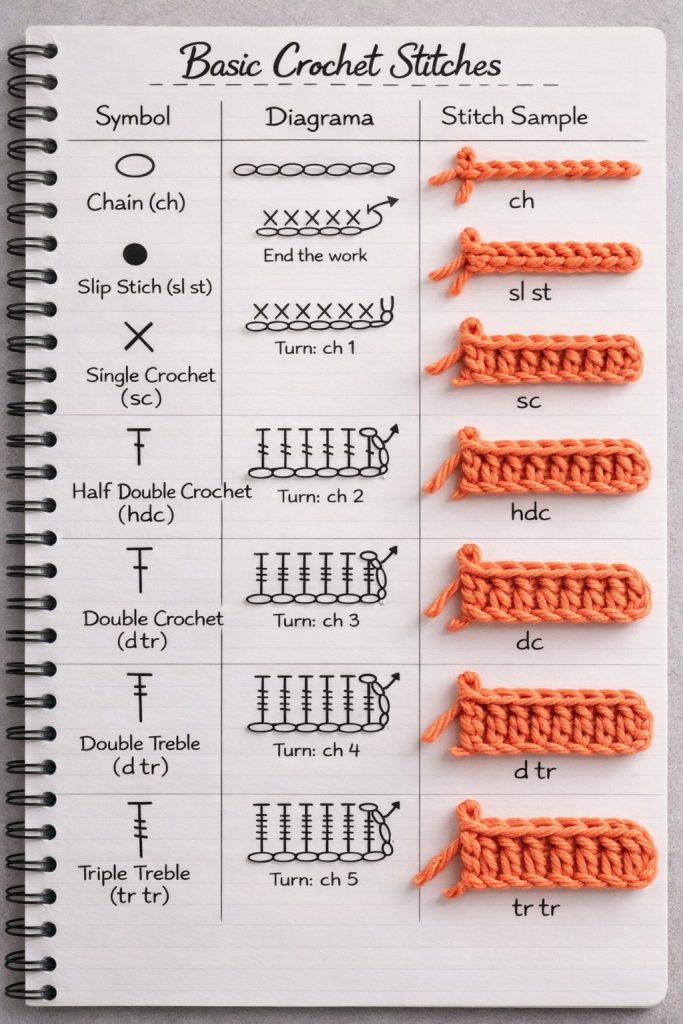
The journey into Basic Crochet Stitches begins with the chain stitch, often abbreviated as CH in patterns. The chain stitch forms the starting foundation for most crochet projects. It creates a flexible base that determines the width of your piece, and learning to maintain even tension at this stage is crucial for consistent results.
To create a chain stitch, you yarn over and pull the yarn through the loop on your hook. Although this sounds simple, beginners often struggle with tight or uneven chains. Practicing slow, steady movements will help you achieve a uniform foundation, which makes working future rows much easier.
Another essential component of Basic Crochet Stitches is the slip stitch, commonly abbreviated as SL ST. The slip stitch is primarily used to join rounds, finish edges, or move your hook to a different position without adding height to your work. It is one of the shortest and flattest stitches in crochet.
The slip stitch is made by inserting the hook into a stitch, yarn over, and pulling the yarn through both the stitch and the loop on the hook at the same time. Because it adds minimal height, it is perfect for shaping and joining pieces seamlessly.
Both the chain stitch and slip stitch play supportive roles in crochet patterns. While they may seem less exciting than taller stitches, they are indispensable in shaping, connecting, and finishing projects properly.
Mastering these first two Basic Crochet Stitches ensures that your projects begin and end neatly. A strong foundation leads to cleaner edges, balanced tension, and a more professional-looking finished piece.
Among the most commonly used Basic Crochet Stitches is the single crochet, abbreviated as SC. This stitch creates a dense and sturdy fabric, making it ideal for projects like amigurumi, dishcloths, and warm accessories. The compact structure of single crochet provides durability and shape retention.
To form a single crochet stitch, insert your hook into the stitch, yarn over and pull up a loop, then yarn over again and pull through both loops on the hook. While the steps are straightforward, maintaining consistent tension is key to achieving uniform rows.
The half double crochet, abbreviated as HDC, is slightly taller than single crochet and offers more flexibility in texture. It creates a fabric that is softer and more breathable while still maintaining structure. Many beginners find this stitch comfortable because it works up quickly without being overly complex.
To make a half double crochet, yarn over before inserting your hook into the stitch. After pulling up a loop, yarn over again and pull through all three loops on the hook. This extra yarn over gives the stitch additional height compared to single crochet.
Both single crochet and half double crochet are versatile Basic Crochet Stitches that appear in countless patterns. They are often used in blankets, scarves, hats, and even home décor projects.
Practicing these stitches in rows helps build muscle memory and confidence. As you repeat them, your hands will naturally adjust to the rhythm of crocheting, making your stitches more even and your projects more polished.
The double crochet, abbreviated as DC, is one of the most popular Basic Crochet Stitches due to its balance between height and speed. It works up faster than shorter stitches and creates a lighter, more flexible fabric. This stitch is commonly used in blankets, shawls, and garments.
To create a double crochet, yarn over, insert your hook into the stitch, yarn over and pull up a loop, yarn over and pull through two loops, then yarn over again and pull through the remaining two loops. Although it involves multiple steps, the motion quickly becomes natural with practice.
The treble crochet, sometimes called triple crochet and abbreviated as TR, is even taller. It creates an airy, open texture that is ideal for lace patterns and decorative projects. Because of its height, it allows projects to grow quickly in length.
To make a treble crochet, yarn over twice before inserting your hook into the stitch. After pulling up a loop, yarn over and pull through two loops three times until only one loop remains on the hook. The extra yarn over at the beginning adds significant height.
These taller Basic Crochet Stitches are especially useful when designing patterns with drape and movement. Garments and lightweight blankets often benefit from the softness that double and treble crochet provide.
As you practice double and treble crochet, pay attention to stitch height consistency. Even spacing and tension ensure that your rows remain straight and your finished piece looks balanced and professional.
Learning Basic Crochet Stitches takes time, but consistent practice makes a significant difference. Start with small swatches rather than large projects. This allows you to focus on technique without feeling overwhelmed by size or complexity.
Choose a medium-weight yarn and a comfortable hook size when practicing. Lighter colors are often easier to work with because they allow you to clearly see each stitch. Avoid very dark or fuzzy yarns in the beginning, as they can make it difficult to identify loops.
Understanding crochet terminology is also essential when mastering Basic Crochet Stitches. Many patterns use standard abbreviations such as CH, SL ST, SC, HDC, DC, and TR. Familiarizing yourself with these abbreviations will make reading patterns much easier and less intimidating.
Another helpful tip is to count your stitches at the end of each row. This prevents accidental increases or decreases and ensures your project maintains the correct shape. Consistency is key to producing clean edges and straight lines.
Do not be discouraged by small mistakes. Even experienced crocheters occasionally unravel rows to fix errors. Viewing mistakes as learning opportunities will help you grow your skills more quickly.
Finally, remember that mastering Basic Crochet Stitches opens the door to advanced techniques such as textured stitches, lacework, and intricate motifs. Every complex pattern is built upon these foundational skills, making them the most important step in your crochet journey.
FAQ About Basic Crochet Stitches
What are the most important Basic Crochet Stitches for beginners?
The most important Basic Crochet Stitches for beginners are the chain stitch, slip stitch, single crochet, half double crochet, double crochet, and treble crochet. These stitches form the base of most crochet patterns and projects.
How long does it take to learn Basic Crochet Stitches?
The time it takes to learn Basic Crochet Stitches varies from person to person. With regular practice, many beginners feel comfortable with the fundamentals within a few days to a couple of weeks.
Why are my crochet stitches uneven?
Uneven stitches are usually caused by inconsistent tension. Practicing regularly and paying attention to how tightly you hold the yarn will help improve the consistency of your Basic Crochet Stitches.
What is the easiest stitch to start with?
The chain stitch and single crochet are often considered the easiest Basic Crochet Stitches for beginners because they involve simple movements and fewer steps.
Can I create projects using only Basic Crochet Stitches?
Yes, many beautiful and functional projects can be made using only Basic Crochet Stitches. Blankets, scarves, hats, and home décor items often rely solely on these foundational techniques.
Do I need special tools to practice Basic Crochet Stitches?
No special tools are required beyond yarn and a crochet hook. Choosing a comfortable hook and smooth yarn will make practicing Basic Crochet Stitches easier and more enjoyable.
VIDEO TUTORIAL
In this complete guide to Basic Crochet Stitches, we explored the essential techniques that form the backbone of crochet. From the foundational chain stitch and slip stitch to the versatile single crochet, half double crochet, double crochet, and treble crochet, each stitch plays a vital role in creating beautiful handmade pieces. By understanding how these stitches work and practicing them consistently, you build the skills necessary to tackle more advanced patterns with confidence.
Mastering Basic Crochet Stitches is not just about learning movements; it is about developing rhythm, patience, and creativity. With dedication and regular practice, your stitches will become more even, your projects more refined, and your confidence stronger.
Now that you have learned the fundamentals of Basic Crochet Stitches, I would love to hear from you. What stitch do you find the easiest or most challenging? Leave your honest opinion and share your suggestions. Your feedback can inspire and support other beginners on their crochet journey.