Crochet Lucky Charm Pattern

Crochet Lucky Charm Pattern is a delightful project that combines creativity, tradition, and practical crochet techniques into a charming handmade accessory. Whether you are looking to decorate bags, keychains, gifts, greeting cards, or seasonal decorations, this beautiful four-leaf clover design is an excellent choice
. Besides being quick to make, it is also a wonderful project for beginners who want to improve their skills while creating something meaningful. Throughout this guide, you will learn every important step needed to create your own Crochet Lucky Charm Pattern using clear US crochet terminology and detailed stitch explanations.
One of the reasons the Crochet Lucky Charm Pattern has become so popular is its versatility. A finished clover can be used as an appliqué, bookmark embellishment, lucky gift, garland decoration, scrapbook ornament, or even combined with other motifs to create blankets, pillows, tote bags, and home décor projects. Since each clover requires only a small amount of yarn, it is also a fantastic stash-busting project that helps reduce leftover yarn while producing beautiful handmade pieces.
This tutorial focuses on building the motif from the center outward while carefully explaining every stitch abbreviation and movement. Using standard US crochet terminology ensures consistency and makes the instructions easier to follow for crocheters around the world. By the end of this article, you will understand how each petal is formed, how the stem is created, and how small finishing techniques can transform a simple motif into an elegant decorative piece. With patience and practice, your Crochet Lucky Charm Pattern will become one of your favorite quick crochet projects.
Before beginning your Crochet Lucky Charm Pattern, gather all necessary materials. A lightweight cotton yarn works beautifully because it produces crisp stitch definition while keeping the clover lightweight. Cotton also holds its shape well, making the finished motif suitable for decorations and accessories.
A crochet hook appropriate for your yarn weight is equally important. For DK or light worsted cotton yarn, many crocheters prefer a 3.5 mm or 4 mm hook. If you want a slightly firmer fabric, choose a smaller hook. For a softer drape, use a larger hook.
Other helpful tools include sharp embroidery scissors, a tapestry needle for weaving in yarn tails, and stitch markers if you are still becoming comfortable working into a Magic Ring. These simple tools make finishing easier and help produce cleaner results.
Understanding the stitch abbreviations before starting will make the project much smoother. This pattern uses common US crochet stitches including MR (Magic Ring), ch (chain), sl st (slip stitch), tr (treble crochet), and st (stitch). Becoming familiar with these abbreviations allows you to crochet confidently without constantly stopping to interpret instructions.
The center of the motif begins with a Magic Ring, which allows the hole in the middle of the clover to close tightly after completing the petals. This technique creates a neat, professional-looking center that is much cleaner than beginning with a chain circle.
Although the motif appears detailed, it is actually built by repeating the same petal sequence four times. Once you complete the first petal, the remaining petals become much easier because you simply repeat the identical stitch sequence around the Magic Ring.
Begin by creating a Magic Ring (MR). Hold the yarn comfortably around your fingers, insert your hook into the adjustable loop, yarn over, and pull up a loop. Secure the ring with one chain if desired, depending on your preferred Magic Ring method. Do not tighten the ring yet, as you will need room to work all four petals.
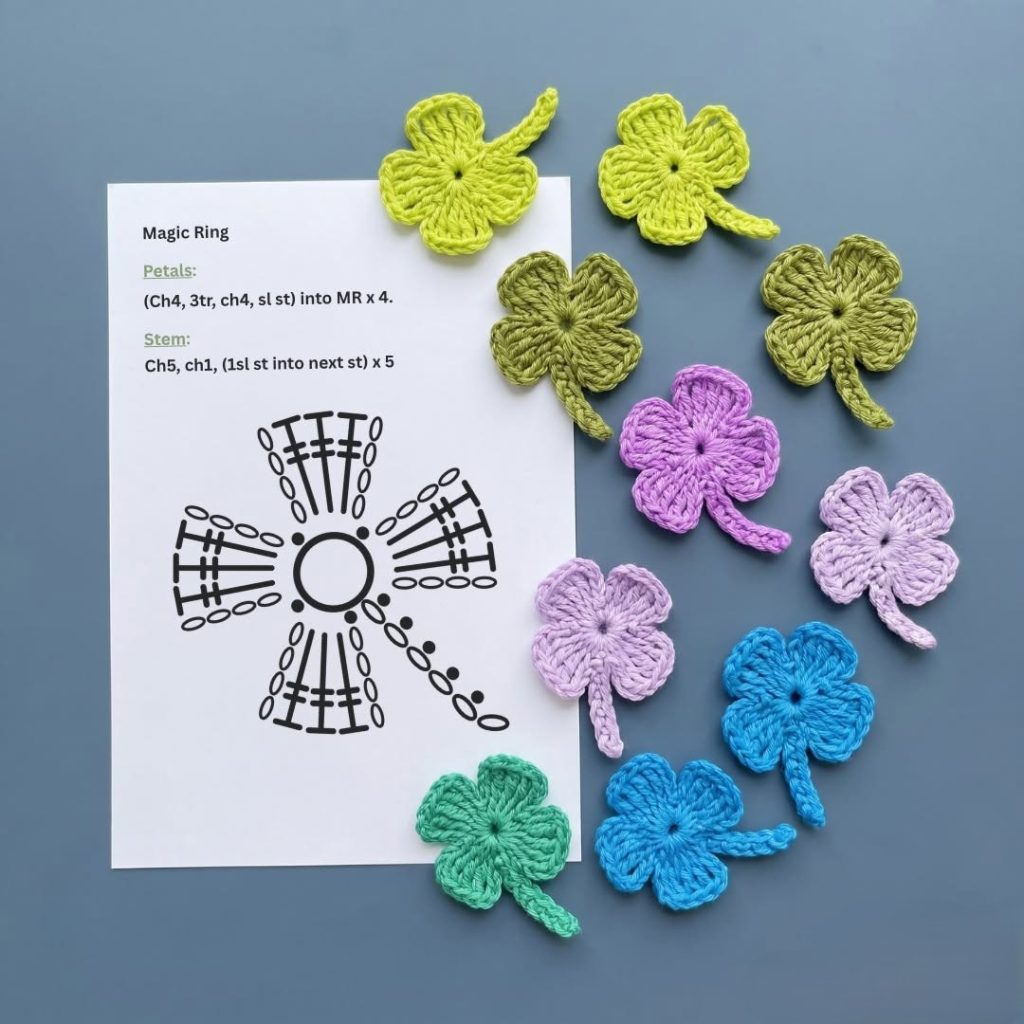
Each petal follows the same stitch sequence. Work directly into the Magic Ring using the following US crochet notation:
Petal Pattern:
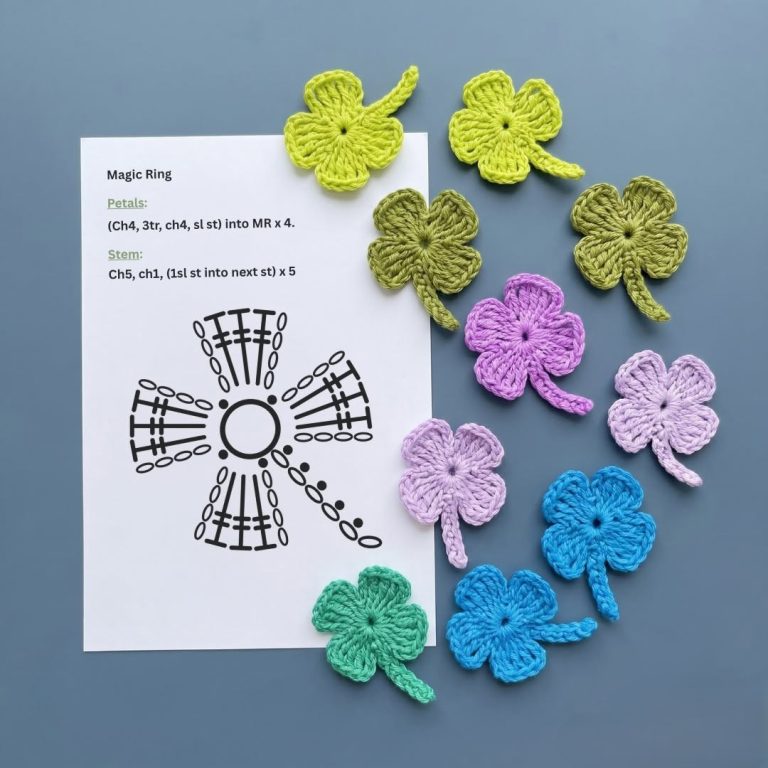
(Ch 4, 3 tr, ch 4, sl st) into MR × 4
This means:
Round 1
MR
After completing all four petals, gently pull the Magic Ring tail to close the center securely. Adjust each petal with your fingers so they are evenly distributed around the circle. The petals should naturally resemble a four-leaf clover with rounded edges.
Next, begin forming the stem directly from the base of the final petal. The stem is intentionally simple so that the main focus remains on the clover itself while adding an attractive finishing detail.
Stem Pattern:
Ch 5, ch 1, (1 sl st into next st) × 5
This sequence creates a slender stem with enough flexibility to curve naturally. Working slip stitches back along the chain also thickens the stem slightly, giving it a polished appearance without adding unnecessary bulk.
Once the stem reaches the base of the clover, fasten off the yarn leaving a small tail. Thread the yarn tail onto a tapestry needle and weave it neatly through the back of several stitches before trimming the excess. Taking time during this finishing step prevents the motif from unraveling and gives your Crochet Lucky Charm Pattern a professional appearance.
One of the greatest advantages of the Crochet Lucky Charm Pattern is how easily it can be personalized. By simply changing the yarn color, fiber type, or hook size, you can create completely different looks while following the exact same stitch sequence. Bright green shades create a traditional lucky clover, while pastel colors produce delicate spring decorations that are perfect for gifts and seasonal displays.
Experimenting with different yarn weights also changes the final appearance of the motif. Fine crochet cotton produces miniature clovers that work beautifully as earrings, greeting card embellishments, or jewelry accents. Medium-weight cotton yarn creates sturdy appliqués suitable for tote bags, hats, and home décor, while bulky yarn results in oversized decorative pieces ideal for wreaths and festive wall hangings.
Blocking is an optional but highly recommended finishing step. Lightly dampen the completed clover, gently shape each petal with your fingers, and pin the motif onto a blocking board until completely dry. Blocking helps the petals remain symmetrical and gives the finished Crochet Lucky Charm Pattern a crisp, polished appearance.
Color combinations offer endless creative possibilities. Traditional emerald green symbolizes luck and nature, but soft mint, sage, olive, turquoise, lavender, blush pink, cream, or even rainbow color palettes create unique versions suitable for every season. Multicolored yarn can also produce beautiful gradients that make each clover one of a kind.
If you enjoy adding extra decorative details, consider sewing a small pearl, crystal bead, tiny wooden button, or embroidered French knot into the center of the clover. These subtle embellishments give the project a handmade artisan feel without distracting from the clean crochet stitches.
Once you’ve mastered the basic pattern, you can crochet multiple clovers in coordinating colors and combine them into larger decorative projects. A collection of small motifs quickly transforms into beautiful bunting, bookmarks, framed artwork, baby mobiles, or festive table decorations while still showcasing the elegance of the original Crochet Lucky Charm Pattern.
The completed Crochet Lucky Charm Pattern is much more than a simple appliqué. Because of its compact size and symbolic meaning, it can become part of countless handmade gifts and decorative projects. Many crocheters enjoy attaching a finished clover to handmade cards as a thoughtful keepsake that recipients can remove and treasure long after the occasion has passed.
Another popular idea is transforming the motif into a keychain or bag charm. Simply attach a small jump ring or keyring through one petal and reinforce the back with a few extra stitches. This creates a lightweight accessory that carries the symbolism of good fortune while showcasing beautiful handcrafted work.
The motif also works wonderfully as a decorative patch on clothing. Sew one or several clovers onto denim jackets, children’s sweaters, canvas totes, aprons, or crochet blankets. The simple shape complements many different handmade projects without overwhelming the overall design.
If you enjoy seasonal decorating, create a collection of Crochet Lucky Charm Pattern motifs in various shades of green for spring displays or festive celebrations. String multiple clovers together to form a garland, decorate a wreath, embellish gift wrapping, or create unique table centerpieces that celebrate handmade craftsmanship.
As your crochet skills improve, focus on maintaining even tension throughout every stitch. Consistent tension ensures that each petal matches the others in size and shape, giving the finished clover a balanced appearance. If one petal appears larger than the rest, gently adjust the stitches before tightening the Magic Ring completely.
Finally, remember that every crochet project becomes more beautiful with practice. Do not be discouraged if your very first clover is not perfectly symmetrical. Each repetition strengthens your stitch consistency, improves your understanding of stitch placement, and increases your confidence. Before long, creating a beautiful Crochet Lucky Charm Pattern will become a relaxing project that you can complete in just a short amount of time while producing charming handmade gifts and decorations.
1. Is the Crochet Lucky Charm Pattern suitable for beginners?
Yes. The Crochet Lucky Charm Pattern is an excellent beginner-friendly project because it uses a small number of basic stitches repeated throughout the design. If you already know how to make a Magic Ring, chain (ch), slip stitch (sl st), and treble crochet (tr), you can complete this project with confidence. Even if the Magic Ring feels challenging at first, practicing it a few times will quickly improve your technique.
2. What yarn works best for this pattern?
Cotton yarn is generally the best option because it provides excellent stitch definition and helps the petals maintain their shape. Mercerized cotton creates a slightly shiny finish, while standard cotton gives the motif a soft, natural appearance. Acrylic yarn can also be used if you prefer a softer texture or want to coordinate with larger crochet projects.
3. Can I make the clover larger or smaller?
Absolutely. The easiest way to resize the Crochet Lucky Charm Pattern is by changing the yarn weight and crochet hook size. Lightweight yarn with a smaller hook creates miniature charms, while thicker yarn and a larger hook produce oversized decorative clovers. The stitch pattern itself remains exactly the same.
4. What does MR mean in crochet?
MR stands for Magic Ring (also called a Magic Circle). This technique creates an adjustable center that can be tightened after all stitches are completed. Using a Magic Ring produces a neat center without leaving a visible hole, making it ideal for floral motifs and lucky clovers.
5. Why are my petals different sizes?
Uneven petals usually result from inconsistent yarn tension or varying stitch heights. Try counting every stitch carefully and maintaining a relaxed but even tension throughout the project. After tightening the Magic Ring, gently shape each petal with your fingers before weaving in the yarn ends.
6. Can I use this motif on other crochet projects?
Definitely. The Crochet Lucky Charm Pattern works beautifully as an appliqué for blankets, scarves, tote bags, hats, baby items, pillows, table runners, bookmarks, wall hangings, keychains, garlands, gift wrapping, and scrapbook decorations. Its versatility makes it one of the most useful small crochet motifs to have in your collection.
7. Which crochet abbreviations are used in this pattern?
This project follows standard US crochet terminology:
Learning these abbreviations will make it easier to follow many other crochet patterns as well.
8. How do I keep the finished clover flat?
Blocking is highly recommended. Lightly mist the finished clover with water, gently shape each petal, pin it onto a blocking mat, and allow it to dry completely. This simple finishing technique helps the petals remain even and gives the Crochet Lucky Charm Pattern a professional finish.
Video Tutorial:
The Crochet Lucky Charm Pattern is a beautiful combination of simplicity, creativity, and timeless symbolism. Throughout this guide, you learned how to select the right materials, understand the essential US crochet abbreviations, and work the project step by step using a Magic Ring, chains, treble crochet stitches, and slip stitches. By repeating a simple petal sequence and adding a delicate stem, you can create an elegant four-leaf clover that is both decorative and meaningful.
You also discovered how to customize your project with different yarn colors, hook sizes, and embellishments to create unique handmade pieces for every season. Whether you choose to use your finished clovers as appliqués, keychains, greeting card decorations, garlands, home décor, gift toppers, or accessories, the Crochet Lucky Charm Pattern offers endless opportunities for creativity while helping you build confidence in your crochet skills.
With practice, you’ll find that this pattern becomes quicker and more enjoyable to make, allowing you to produce beautiful handmade lucky charms for friends, family, craft fairs, or your own collection. Every completed clover is an opportunity to refine your technique, improve your stitch consistency, and enjoy the relaxing process of crochet.
Thank you for following this complete Crochet Lucky Charm Pattern tutorial. I hope it has inspired you to pick up your hook, experiment with new color combinations, and create many beautiful lucky clovers. If you enjoyed this tutorial, please leave your honest opinion in the comments and share your experience making this pattern. Your sincere feedback, creative ideas, and suggestions for future crochet tutorials are always appreciated and help inspire even more handmade projects for the crochet community.